 English
  Suomi
Suomi Svenska
 Français
Introduction
Understanding the nuances of Cardiopulmonary Resuscitation (CPR) is essential for an effective emergency response. A particularly critical scenario is: how does standard protocol change when dealing with CPR for choking victim emergencies? In such situations, where a blocked airway leads to unconsciousness, standard procedures must be modified. This guide explores these specialized techniques and the role of advanced equipment, such as ileria CPR feedback devices, in managing high-pressure emergencies.
Understanding Standard CPR Basics vs. Airway Obstructions
To respond effectively, one must comprehend the fundamentals of resuscitation before understanding how CPR for choking victim situations differ. Standard CPR is a life-saving procedure used when a person’s heart has stopped or is failing to circulate enough oxygenated blood. Standard protocols involve both chest compressions and rescue breathing. Chest compressions mimic the heart’s natural pumping action, while rescue breaths provide essential oxygen to the lungs.
While the standard protocol is designed for primary cardiac episodes, adjustments are necessary when the victim is choking to address the unique challenges of a completely blocked airway.

Recognizing an Unresponsive Choking Victim
Identifying an adult choking victim who has become unresponsive is essential for prompt assistance. Initially, the victim may show distress signals like clutching the throat (the universal sign of choking), coughing, or wheezing.
If the airway remains completely blocked, oxygen depletion leads to a loss of consciousness. Once the victim is unresponsive, the priority shifts from the Heimlich maneuver to a modified version of CPR for choking victim protocols designed to clear the obstruction.
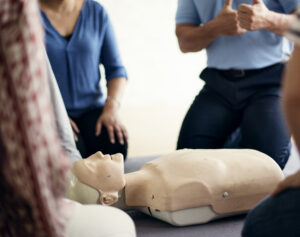
How Does CPR Differ for Choking Victim Emergencies?
Regarding the question of how procedures differ in these cases, the primary shift is the immediate prioritization of chest compressions. Unlike standard CPR, where the goal is simply circulation, compressions in CPR for choking victim scenarios serve a dual purpose: they circulate blood and create internal pressure that may dislodge the obstructing object.
Another critical difference lies in the airway check. Before each set of rescue breaths, the responder must look into the mouth for the obstructing object. Furthermore, traditional abdominal thrusts (Heimlich maneuver) are replaced by chest compressions once the victim is lying on the ground, as this is more effective and safer for an unconscious individual.

1. Assess the Situation and Call for Help
Ensure the scene is safe. If the victim is unresponsive and not breathing, call emergency services immediately and retrieve an AED and an ileria CPR feedback device if available.
2. Perform High-Quality Chest Compressions
Start chest compressions immediately. Position the heel of your hand in the center of the chest. Because the goal is also to dislodge an object, maintaining proper CPR for choking victim standards is vital. Using a CPR feedback device ensures you are maintaining the correct depth and rate (100–120 bpm), providing the best chance to create enough upward pressure to clear the airway.
3. Check the Mouth (The Visual Sweep)
After 30 compressions, open the airway and look inside the mouth. If you see the obstructing object, carefully remove it. Do not perform a blind finger sweep, as this can push the object deeper into the throat.
4. Attempt Rescue Breaths
If the object is removed (or if you cannot see it), attempt two rescue breaths. If the chest does not rise, reposition the head and try again. The resistance felt during these breaths confirms if the airway is still blocked.
5. Repeat the Resuscitation Cycle
Continue the cycle of 30 compressions, checking the mouth, and attempting breaths. Do not incorporate back blows or standing abdominal thrusts once the victim is unresponsive; stay focused on high-quality CPR for choking victim steps on a firm surface.

Conclusion
The question of how protocols change highlights the need for a specialized approach to airway emergencies. By prioritizing chest compressions, performing visual airway checks, and utilizing real-time guidance from ileria feedback technology, responders can address the dual challenges of choking and cardiac arrest with confidence. In these life-threatening situations, every second counts, and having the right knowledge—and the right tools—can make the ultimate difference.