 English
  Suomi
Suomi Svenska
 Français
Introduction
The importance of strong, effective team dynamics in CPR—where every second counts—cannot be overlooked. When several rescuers work together to save a life, their capacity to cooperate, communicate seamlessly, and remain composed under pressure becomes the key to success. This guide explores how coordinated actions and cooperative efforts within a resuscitation team can have a significant impact on patient survival.
As we delve into the complexities of life-saving interventions, we examine the specific roles played by team members, communication tactics, leadership structures, and the tools that support a high-performance response based on proven team dynamics in CPR.
Core Components of High-Performance Team Dynamics in CPR
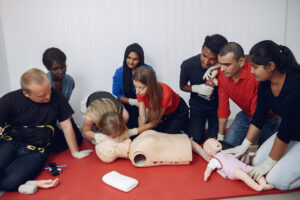
First and foremost, the function of a Team Leader is of utmost significance. This individual coordinates role changes, gathers crucial clinical information, and maintains an objective, “all-seeing” perspective of the resuscitation scenario. Interestingly, a trained healthcare professional can effectively perform this leadership function, allowing specialists to focus on urgent medical decisions and advanced interventions without being distracted by the minute details of CPR management.
Additionally, flawless role distribution is essential. A high-performance team dynamics in CPR typically includes:
-
Compressor: Focuses on high-quality chest compressions.
-
Airway/Ventilation Expert: Manages oxygenation and breaths.
-
AED/Monitor/Defibrillator Steward: Operates the shock device and monitors rhythms.
-
Medication/IV Specialist: Handles vascular access and drugs.
-
Timekeeper/Recorder: Documents the timeline and medications given.
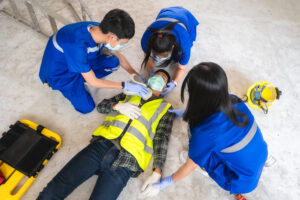
The Power of Closed-Loop Communication
Communication is the lifeline of effective team dynamics in CPR. In high-stress medical emergencies, sharing real-time information is vital to guide the team’s actions.
Closed-Loop Communication is a methodical strategy used to improve accountability and clarity. It involves three essential steps:
-
The Sender gives a specific order (e.g., “Administer 1mg of Epinephrine”).
-
The Receiver repeats the order back to confirm (e.g., “I am administering 1mg of Epinephrine“).
-
The Sender confirms the receipt (e.g., “Correct”).
This process ensures the precise transmission of critical instructions while avoiding errors in a multidisciplinary environment.
Common Pitfalls: Things to Avoid in a CPR Team
To maintain successful team dynamics in CPR, teams must be aware of critical errors that can jeopardize patient outcomes:
-
Insufficient Communication: Failing to transmit changes in the patient’s status or rising concerns can lead to chaos. CPR teams must avoid communication breakdowns by utilizing consistent vocabulary and identifying a committed communicator.
-
Role Ambiguity: Confusion regarding individual duties can lead to overlapped actions or the neglect of vital tasks. Regular drills and clear assignments are necessary to prevent these setbacks.
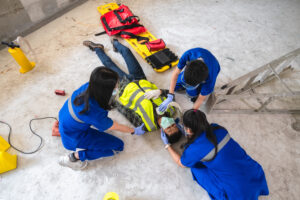
Enhanced Precision with the ileria CPR Feedback Device
Effective team dynamics in CPR are significantly improved when using real-time data. The ileria CPR feedback device acts as an objective observer for the entire rescue team.
-
Data-Driven Decisions: Team members can adjust their actions based on the device’s immediate feedback on compression depth, rate, and recoil.
-
Quality Assurance: As the leader monitors the feedback from the ileria device, they can provide specific coaching to the compressor (e.g., “Push a bit deeper” or “Ensure full recoil”), ensuring the highest quality of CPR is maintained throughout the effort.

Key Factors That Contribute to High-Performance Teams
-
Clear Roles: Every member knows exactly where to stand and what to do.
-
Leadership: A designated leader keeps the team focused and prevents “tunnel vision.”
-
Training and Competence: Regular practice builds the muscle memory required for fluid collaboration.
-
Psychological Safety: A culture where any team member feels comfortable raising a concern encourages trust and improves patient safety.
Conclusion
Achieving effective team dynamics in CPR is more than just a set of individual skills; it is a synchronized effort to beat the clock. By combining clear leadership, closed-loop communication, and advanced technology like the ileria CPR feedback device, medical teams can transform a chaotic scene into a precise life-saving operation. At ileria, we believe that the right tools empower the best teams to achieve the ultimate goal: saving a life.
Frequently Asked Questions (FAQs)
1. Can a nurse lead a CPR team?
Yes. Anyone with the appropriate training and a clear understanding of the protocols can serve as a Team Leader, coordinating the team dynamics in CPR while others perform manual tasks.
2. What is the most common error in CPR team dynamics?
Lack of communication and excess “noise” at the scene. Effective teams maintain a quiet, structured environment so that orders can be heard and confirmed clearly.
3. How does the ileria device help the Team Leader?
The ileria device provides an objective metric. Instead of guessing if compressions are deep enough, the leader can see the real-time data and make precise adjustments, ensuring successful team dynamics in CPR even as fatigue sets in.